


Virtual HIT project management in healthcare, often with virtual teams, is growing in practice by leaps and bounds. In fact, a staggering 60% of project management is now done virtually, and this extends to HIT projects.
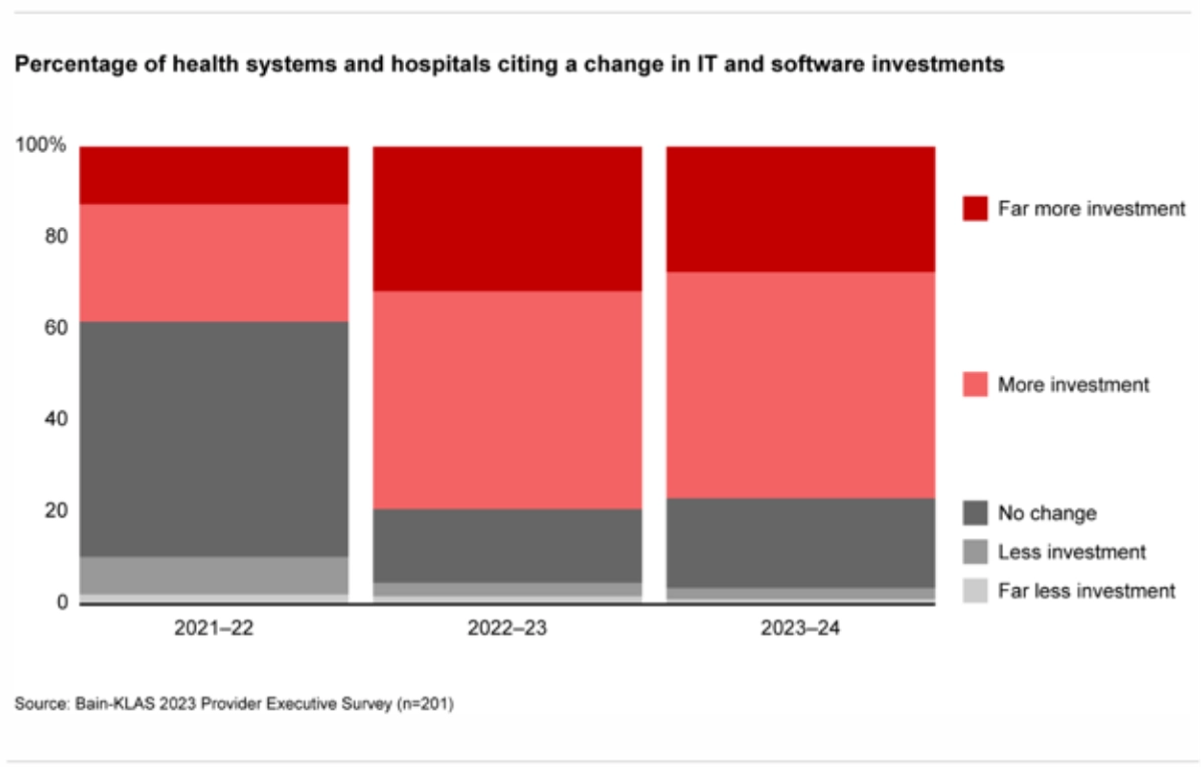
Hospital IT and software investments continue to grow as hospitals seek improved systems that support goals at the lowest cost.
Why is this trend becoming so popular? For one, HIT workforce demographic shifts are making virtual IT projects possible, with HIT project managers now having access to a ready source of virtual IT specialists. That’s because about a third of all IT workers come from the gig economy, and IT and other virtual workers are expected to grow three times faster than the U.S. workforce as a whole.
These virtual project managers are getting a boost from AI, too. Gartner predicts that AI will assume 80% of project management tasks, leaving the human project manager time to focus on more complex issues involving technology, architecture, resource management, and timely delivery, while AI picks up status updates, hours worked, and lists of action items.
With workforce changes and technology advancements supporting this trend toward virtual HIT project management, the stage is set for this new approach. But virtual project management requires some new and different skills.
Five critical success factors for virtual HIT project managers
New management approaches and tools are required to successfully complete virtual HIT projects and then integrate them into existing hospital IT architecture. Here are some tips for success that I’ve learned by virtually managing HIT projects:
1. Leverage online collaboration tools
I’ve been surprised at the effectiveness of online, cloud-based collaboration tools like Slack, MS Teams, JIRA, Monday.com, and MS SharePoint. For status and communications, nothing beats them. Teams respond more quickly to messaging (while avoiding phone tag) and these apps can form a virtual hub to store and share documentation, methodologies, project feedback, and tools. While remote managers can’t physically stand over key players and demand accountability, these new tools do a good (if not better) job of increasing team efficiency and accountability.
2. Simplify documentation
New tools, like Microsoft Loop, integrate multiple applications into one platform for easier feedback. For example, you can build a project charter using Word, PowerPoint, and Excel in the same document so that edits and updates aren’t lost because of app incompatibility.
3. Incorporate soft skills
Even as technology becomes a more pervasive project management tool, it won’t replace or eliminate the need for “people” skills. Understanding the psychology behind driving a team and working with each team member is a soft skill that cannot be replaced. In virtual teams, it’s easy to incorporate 360-degree feedback, which helps to quickly stop misunderstandings and miscommunications. Don’t forget that one-on-ones and check-ins remain just as important in a virtual team as in a face-to-face team.
4. Maintain data integrity
The strength of virtual tools and technology depends on accurate data input. AI can help a project manager with data outputs necessary to run a project, but if the project team isn’t updating and maintaining their status, the outputs won’t be of any value. Bad data can derail a project and lead to lost hospital income or employees quitting. Data errors in healthcare carry even bigger responsibilities than other sectors. Errors could harm patients.
5. Find opportunities for AI and humans to complement each other
A few years ago, the Harvard Business Review coined the phrase “collaborative intelligence” to define the ideal relationship between AI and humans. That same article referred to two researchers from Accenture who studied AI integration in 1,500 companies. They documented that when AI and humans get along and work together, performance improves. The researchers noted that AI is learning to be sympathetic (more human), and those humans managing AI are learning how to manage AI by explaining, modifying, and even preventing AI from dominating and, sometimes, going too far (such as when an AI-driven car causes an accident).
Virtual project management is here to stay
Using these suggestions for managing virtual HIT projects, hospitals already are seeing incredible benefits. They can select a project manager from anywhere in the world, and project teams can be formed with specialists who have the subject matter knowledge and technical skills to work efficiently. Hospital internal IT staffing levels are not impacted and can be supplemental, helping to avoid staff burnout and travel expenses. Time to market is faster. Work is flexible and agile, secure and compliant, and—equally important—cost effective.
In this environment, not surprisingly, hospitals are realizing that there is a direct correlation between a hospital’s ranking and their technological advancements.
For these reasons, the demand for virtual HIT project management is skyrocketing. With 30% of the world’s data volume being generated by the health industry, hospitals face a backlog of emerging technology, from the Internet of Medical Things, to enhanced cybersecurity, remote patient monitoring, FinTech integration, cloud migration, and data analytics. Virtual project management is here to stay—and will be growing in use.