

Healthcare IT project managers are increasingly leveraging AI to improve efficiency, accuracy, and outcomes in healthcare projects. AI tools are managing tasks and project administration, freeing project managers from manual work so they can focus on communication and accountability.
Thanks to AI, project managers are becoming less task managers and more team coaches and communicators with stakeholders. Meanwhile, AI helps with operational oversight, risk and issue management while keeping everyone on track. Already, AI is having a positive impact on project management (see chart).
By 2030, 80% of project management tasks will be run by AI.
Gartner Group
I want to start with an important caveat to using AI in project management: we must recognize that AI is still learning and for now is in a supportive role. AI’s not ready yet to take over project management. AI doesn’t have the ability (yet) to understand the detailed tasks or proprietary activities that occur when building a proprietary vendor software project plan.
But AI can help make sure the plan is optimal on critical path, dependencies, resourcing, and so on.
Even with this limitation, here are some practical AI-use suggestions you can employ today to boost IT project success rates.
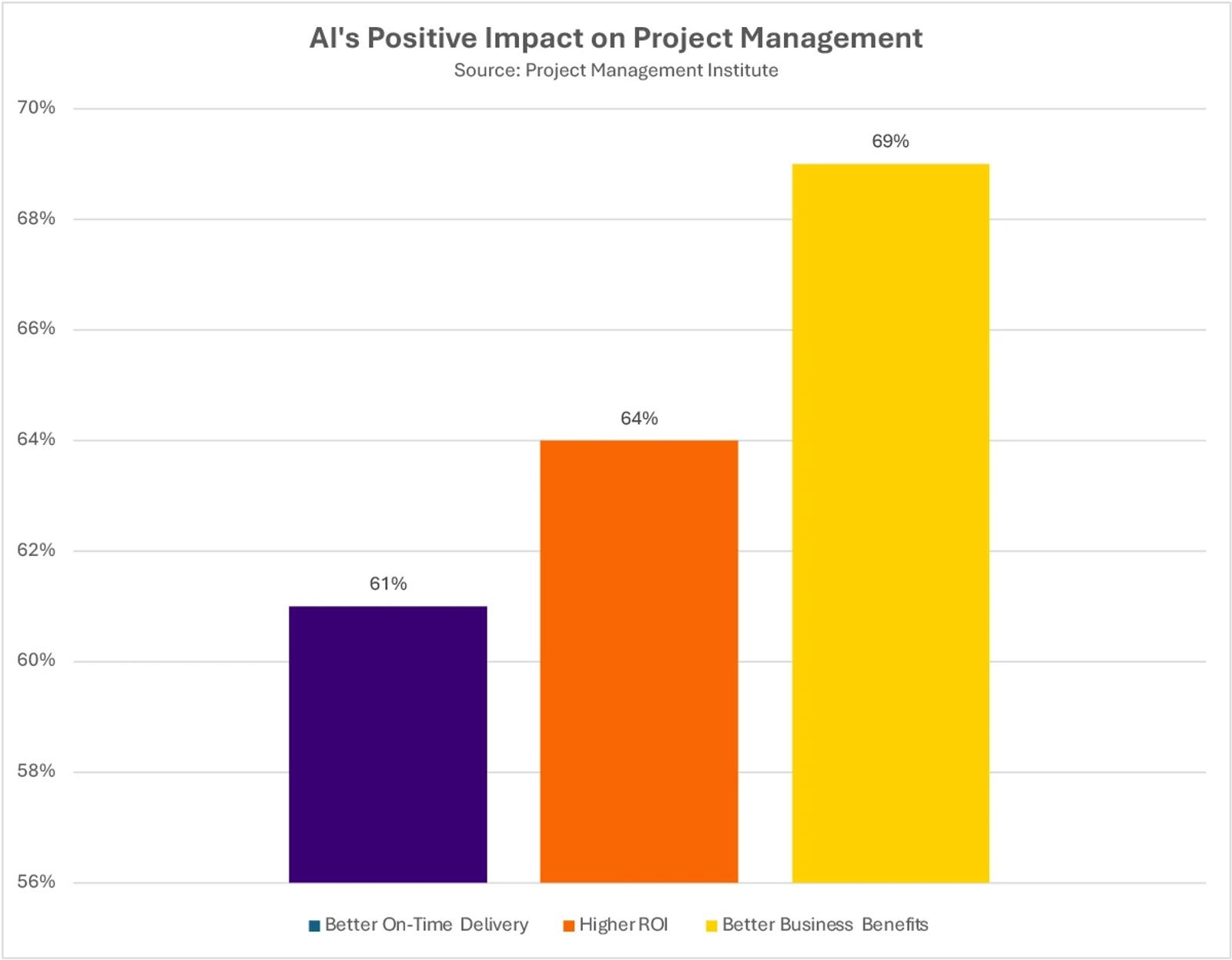
Source: PMI
1. Building a Project Charter
Key to building a project charter is detailing the project definition and Key Performance Indicators. It’s easy to miss some. AI’s Jasper, Claude, Gemini and OpenAI, among other generative AI tools, can have your back. Accessing their help is easy: on the AI tool, list your overall goal and success metrics and then ask what is missing. The same process can uncover adjacent and related risks. These AI scoping tools reveal potential problems such as ambiguities, duplicates, omissions, inconsistencies, and complexities.
2. Support in Creating a Project Plan
AI can generate goals, timelines, and required resources that lay out the most efficient path toward project success. AI tools facilitate scheduling, detailed planning, and resource demands. The human brain can’t match the sophistication of algorithms to digest data and support creating a project plan that considers the critical path, addresses dependencies, allocates resources efficiently, and anticipates roadblocks. Because AI can analyze complex data sets, optimize resources, and predict potential risks, the project plan can be analyzed in a way to anticipate how to optimize team skills and minimize bottlenecks.
3. Monitoring Tasks
According to the Harvard Business Review, “Oracle recently announced a new project management AI digital assistant, which provides instant status updates and helps users update time and task progress via text, voice or chat.” The benefit of AI is its ability to identify task status and then solve issues related to time overruns, cost escalation, and risk mitigation. More sophisticated existing AI and ML applications using big data are available to anticipate risks. The tools propose mitigating actions and adjusting plans automatically to avoid certain types of risk. Some applications include AI assistants that sense delays or scope creep before they happen and automatically send out emails to keep everyone on track.
Best AI for Project Management
An explosion of AI tools are available. Here’s a recent list from independent TechRepublic:
Best for affordable pricing: Trello
Best for customizations:ClickUp
Best for writing assistance: Notion
Best for unique AI features: Wrike
Best for included AI features: Asana
Best for teams of most sizes: monday.com
Best for Microsoft 365 users: Microsoft Project
Best for AI-enhanced automation: Zapier
Best for AI-driven document collaboration: Coda
4. Status Updates and Stakeholder Communications
Virtual assistants can automate status updates, risk assessment, and stakeholder analysis.
It’s not always easy for a technology person to communicate project status or updates in language that users can understand. AI chatbots like ChatGPT can translate technical terms. Other tools exist to collect and analyze user stories, converting them into common language. In the query, say something like, “Explain the status of this update (provide technical details) in simple terms that a non-technical person can understand.” As with all AI, check and edit the response before sending.
5. User Testing
No part of project management is more cumbersome than user testing. Once users are selected, the tasks include observing, recording, identifying issue logs, and prioritizing fixes. AI tools reduce time and energy around transcribing, text-based video editing and providing machine-learning-based insight. AI also removes bias so that data validation is more objective, and testing is regressive, finding bugs before they happen again.
As proof that the use of AI in project management is going mainstream, Northeastern University has incorporated AI into its project management curriculum. Project managers who incorporate AI will be in demand as healthcare organizations and others adopt higher expectations for successful project outcomes. The tools themselves already are mainstream and available for use.